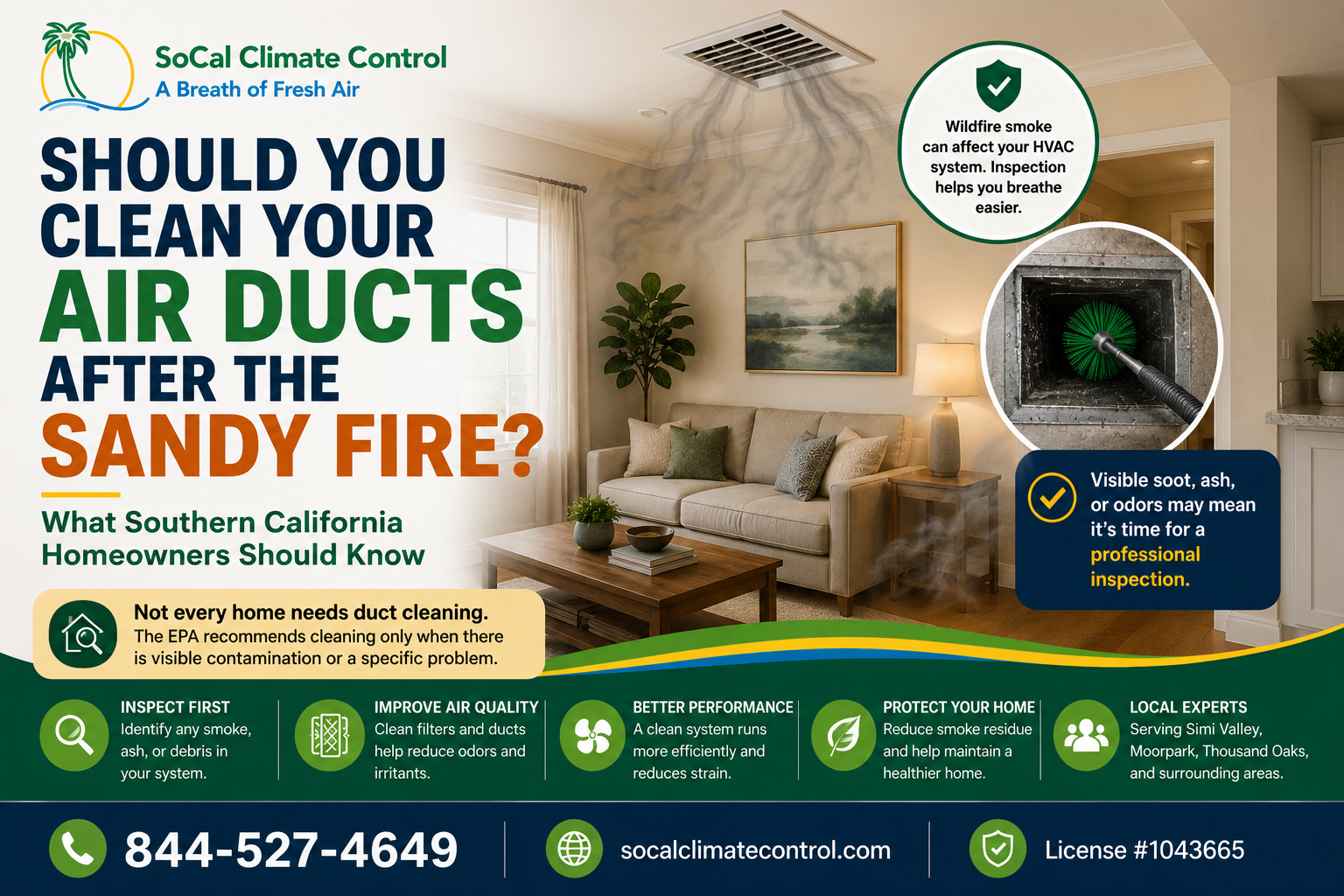
Quick Answer: Should You Clean Your Air Ducts After Wildfire Smoke Exposure?
Sometimes. According to the EPA, air duct cleaning may be appropriate if there is visible soot, ash, debris, persistent smoke odor, or contamination inside accessible ductwork after wildfire smoke exposure. However, the EPA does not recommend automatic duct cleaning for every home affected by wildfire smoke. Homeowners in Simi Valley, Agoura Hills, Westlake Village, Thousand Oaks, Moorpark, and surrounding Southern California communities should consider an HVAC inspection first before deciding whether duct cleaning is necessary.
This guide explains what the EPA actually says about duct cleaning after wildfire smoke, how smoke can affect HVAC systems, what signs homeowners should look for after the Sandy Fire, and when professional inspection may help.
How the Sandy Fire Raised Indoor Air Quality Concerns Across Southern California
The Sandy Fire began in Ventura County near Simi Valley and created smoke conditions that affected nearby communities throughout Ventura County and portions of western Los Angeles County.
Even homes outside evacuation zones experienced smoke odors, haze, ash accumulation, and reduced air quality depending on wind conditions and proximity to smoke plumes.
Communities including Simi Valley, Moorpark, Thousand Oaks, Agoura Hills, Westlake Village, Calabasas, Woodland Hills, West Hills, and Chatsworth experienced varying smoke conditions during the fire event.
As a result, many homeowners became concerned about whether wildfire smoke may have entered their HVAC systems or ductwork.
Official fire updates: CAL FIRE Sandy Fire Incident Page
What the EPA Says About Air Duct Cleaning
The EPA advises homeowners to be cautious about blanket duct cleaning claims. According to the EPA, duct cleaning has not been proven to prevent health problems in every situation, and many homes may not require duct cleaning even after smoke exposure.
The EPA generally recommends duct cleaning only when there is a specific reason, such as:
- Visible mold growth inside hard surface ducts
- Substantial dust or debris buildup
- Vermin infestation
- Visible contamination inside accessible ductwork
- Debris being released into living spaces
For wildfire smoke situations, this means homeowners should look for evidence of contamination rather than assuming every smoke event automatically requires duct cleaning.
EPA resource: Should You Have the Air Ducts in Your Home Cleaned?
Can Wildfire Smoke Enter HVAC Duct Systems?
Yes. Wildfire smoke particles can enter homes through ventilation systems, outdoor air intake systems, duct leakage, attic pathways, return vents, and other openings throughout the home.
Smoke particles are extremely small and may settle inside HVAC filters, return pathways, accessible duct surfaces, or other parts of the HVAC system during prolonged smoke exposure.
Homes in Southern California communities such as Simi Valley, Agoura Hills, Westlake Village, Calabasas, Thousand Oaks, and Woodland Hills may experience different levels of smoke infiltration depending on:
- wind direction
- terrain
- home age
- duct condition
- attic leakage
- filter condition
- ventilation settings
Signs Your Air Ducts May Need Inspection After the Sandy Fire
Not every home needs duct cleaning after wildfire smoke exposure. However, some signs may indicate the HVAC system should at least be inspected.
Possible signs include:
- Persistent smoke odors when the HVAC system runs
- Visible soot or ash near vents
- Dust or debris blowing from registers
- Filters becoming dirty unusually fast
- Reduced airflow
- Smoke smell stronger during HVAC operation
- Heavy ash intrusion into the home
- Visible contamination inside accessible duct areas
These signs do not automatically mean the entire duct system must be replaced or deeply cleaned. They do suggest that an inspection may be appropriate.
When Duct Cleaning May Be Appropriate After Wildfire Smoke
Duct cleaning may be worth considering when there is evidence that smoke particles, ash, or debris entered the HVAC system.
Situations where duct cleaning may help include:
- Homes directly exposed to ash fall
- Visible debris inside ductwork
- Persistent odor problems after filter replacement
- Smoke contamination confirmed during inspection
- Large smoke intrusion events
- Dust or soot being distributed indoors
For homes with minimal smoke exposure and no signs of contamination, replacing the HVAC filter and cleaning indoor surfaces may be enough.
What Duct Cleaning Cannot Do
Homeowners should understand that duct cleaning is not a magic solution.
Duct cleaning may not completely eliminate smoke odor if the odor is also trapped in:
- carpet
- upholstery
- curtains
- attic insulation
- walls and surfaces
- dust throughout the home
This is why some homeowners continue noticing smoke odors even after cleaning parts of the HVAC system.
The most effective approach is usually a combination of:
- filter replacement
- surface cleaning
- air quality management
- source identification
- HVAC inspection
How HVAC Filters Help During Wildfire Smoke Events
HVAC filters are one of the most important defenses during wildfire smoke conditions.
The EPA recommends checking filters frequently during smoke events and replacing them as needed. Smoke particles may clog filters faster than normal.
Many homeowners ask about upgrading to higher-efficiency filters such as MERV 11 or MERV 13 filters during wildfire season.
While higher-efficiency filters may capture smaller particles better, not every HVAC system is designed for highly restrictive filters. A filter that is too dense may reduce airflow or strain the HVAC system.
An HVAC technician can help determine which filter type is appropriate for your system.
Can Smoke Odors Return After Filter Replacement?
Yes. Replacing the filter does not always eliminate smoke odors immediately.
Smoke particles and odor residue may remain in:
- duct pathways
- return grilles
- blower compartments
- indoor surfaces
- attics
- furniture and carpet
This is why some homes continue smelling smoky even after outdoor air quality improves.
Homeowners should avoid assuming the HVAC system alone is responsible for all lingering odors.
What Government Agencies Recommend During Wildfire Smoke Events
The EPA, CDC, and local health agencies recommend reducing smoke exposure indoors during wildfire events.
Recommended actions include:
- Keep windows and doors closed
- Use HVAC recirculation settings when available
- Replace dirty HVAC filters
- Monitor AQI conditions
- Use portable air cleaners if appropriate
- Reduce indoor pollution sources
- Limit outdoor air entering the home during smoke events
Government health resources:
- EPA Wildfires and Indoor Air Quality
- CDC Wildfire Smoke Safety
- Los Angeles County Wildfire Smoke Guidance
How to Improve Indoor Air Quality After the Sandy Fire
Southern California homeowners can take several practical steps after wildfire smoke exposure.
Recommended actions include:
- Replace dirty HVAC filters
- Use HVAC recirculation mode when possible
- Seal obvious air leaks
- Monitor outdoor AQI before opening windows
- Use portable air cleaners if appropriate
- Vacuum using HEPA filtration
- Clean indoor surfaces where ash or dust settled
- Inspect HVAC systems if smoke odor continues
For households with asthma sufferers, seniors, children, or individuals with respiratory conditions, indoor air quality management may be especially important after wildfire smoke exposure.
Local Air Quality & Emergency Resources
Homeowners should continue monitoring official air quality and emergency resources during and after wildfire events.
- AirNow AQI
- South Coast AQMD Advisories
- CAL FIRE Sandy Fire Updates
- Ventura County Emergency Information
- Los Angeles County Emergency Preparedness
When Should You Schedule an HVAC Inspection?
Homeowners in Simi Valley, Moorpark, Thousand Oaks, Agoura Hills, Westlake Village, Calabasas, Woodland Hills, West Hills, Chatsworth, and nearby communities may want to schedule an HVAC inspection if:
- Smoke smell continues indoors
- Smoke odors become stronger when the HVAC system runs
- Dust or soot appears near vents
- Airflow decreases
- Filters become dirty unusually fast
- Indoor air quality symptoms continue
An HVAC inspection may help identify:
- filter issues
- duct leakage
- airflow concerns
- possible contamination areas
- ventilation issues
For local help, visit HVAC indoor air quality specialists in Simi Valley.
Frequently Asked Questions
Does every home need duct cleaning after wildfire smoke?
No. The EPA does not recommend automatic duct cleaning for every home after wildfire smoke exposure.
Can wildfire smoke enter HVAC ducts?
Yes. Smoke particles may enter homes through ventilation systems, duct leakage, outdoor air intake systems, and return pathways.
How do I know if my ducts may need cleaning?
Possible signs include visible soot, ash, persistent smoke odor, dust near vents, or inspection-confirmed contamination.
Should I replace my HVAC filter after the Sandy Fire?
Yes, homeowners should inspect their filters after smoke exposure and replace dirty filters as needed.
Can duct cleaning remove all smoke odor?
Not always. Smoke odor may also remain in carpet, upholstery, insulation, dust, and other indoor materials.
What cities were affected by Sandy Fire smoke?
Communities affected included Simi Valley, Moorpark, Thousand Oaks, Agoura Hills, Westlake Village, Calabasas, Woodland Hills, West Hills, Chatsworth, and nearby Southern California areas.
The Sandy Fire reminded Southern California homeowners how wildfire smoke can affect indoor air quality even when homes are not directly damaged by flames.
While duct cleaning may help in some situations, homeowners should rely on inspection-based evaluations instead of fear-based claims or automatic recommendations.
The most practical approach is to monitor air quality, replace dirty filters, reduce smoke entry into the home, clean indoor surfaces, and schedule an HVAC inspection if smoke odors or airflow problems continue after smoke conditions improve.
Helpful resources: