Last Updated: May 2026After the Sandy Fire in Ventura County, homeowners across Simi Valley, Moorpark, Thousand Oaks, Agoura Hills, Westlake Village, Calabasas, Woodland Hills, West Hills, Chatsworth, and surrounding Southern California communities began searching for ways to improve indoor air quality during wildfire smoke conditions.
One of the most common questions homeowners ask is:
“What is the best HVAC filter for wildfire smoke?”
According to the EPA, higher-efficiency HVAC filters may help reduce fine smoke particles indoors when used in systems that can properly support them. However, not every HVAC system is designed for highly restrictive filters, and homeowners should avoid assuming that the highest-rated filter is automatically the best option for every home.
Quick Answer: What Is the Best HVAC Filter for Wildfire Smoke?
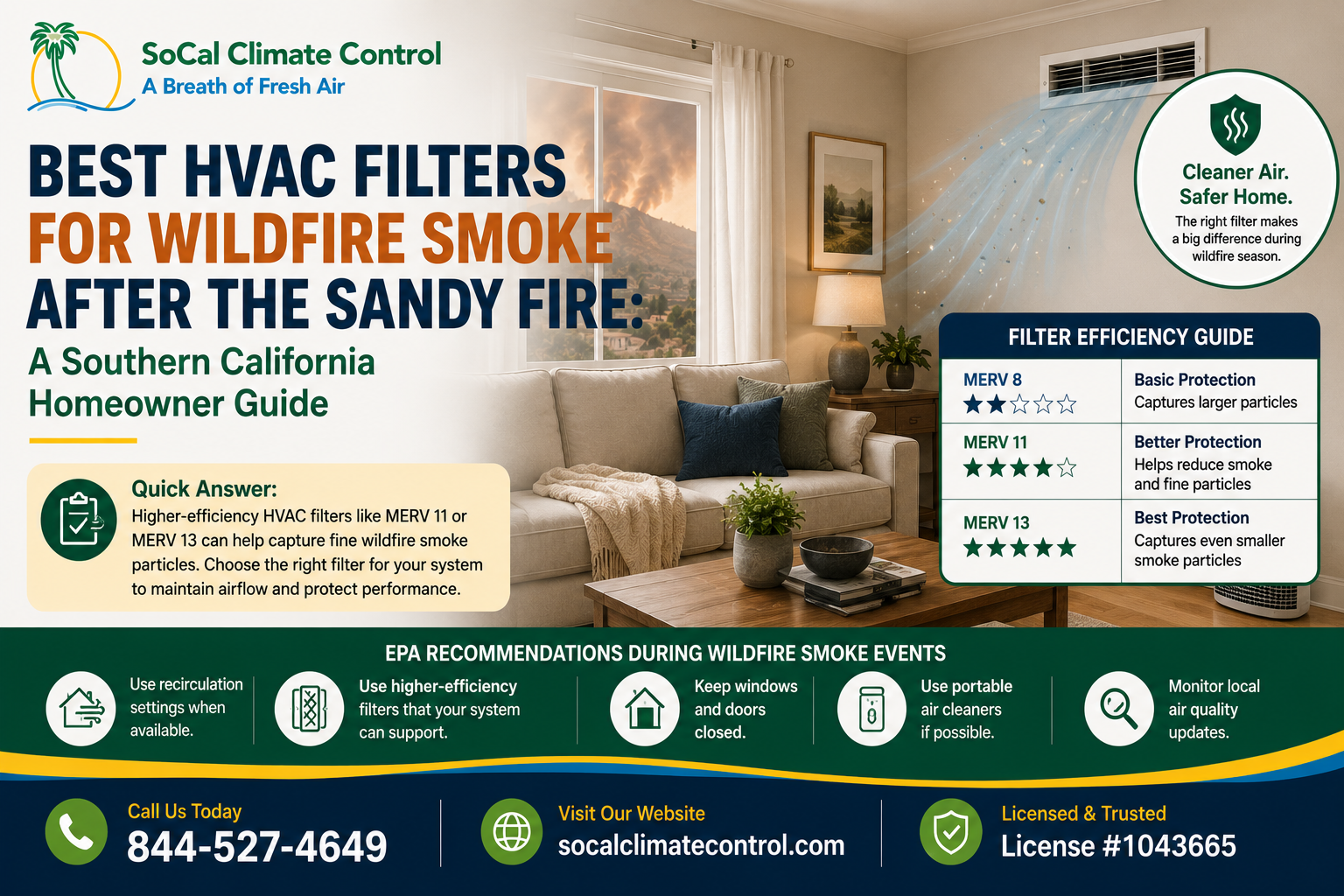
According to the EPA, higher-efficiency HVAC filters may help reduce wildfire smoke particles indoors if the HVAC system can safely support them. Many homeowners use MERV 11 or MERV 13 filters during wildfire smoke events, but filter compatibility depends on the HVAC system’s airflow design and specifications. Homeowners in Simi Valley, Agoura Hills, Westlake Village, Thousand Oaks, Moorpark, and surrounding Southern California communities should have their HVAC system evaluated before installing highly restrictive filters during wildfire season.
This guide explains how HVAC filters work during wildfire smoke events, what MERV ratings mean, when higher-efficiency filters may help, and what Southern California homeowners should know after the Sandy Fire.
How the Sandy Fire Increased Indoor Air Quality Concerns
The Sandy Fire near Simi Valley created smoke conditions that affected nearby communities throughout Ventura County and portions of western Los Angeles County.
Even homes far from active flames experienced smoke odors, haze, and poor air quality depending on wind conditions and local terrain.
Communities including Simi Valley, Moorpark, Thousand Oaks, Agoura Hills, Westlake Village, Calabasas, Woodland Hills, West Hills, and Chatsworth experienced varying smoke conditions during the event.
As smoke conditions spread across Southern California, many homeowners looked for ways to improve indoor air quality, and HVAC filters became one of the most discussed topics.
Official fire information: CAL FIRE Sandy Fire Incident Page
What Is a MERV Rating?
MERV stands for “Minimum Efficiency Reporting Value.” MERV ratings measure how effectively an HVAC filter captures airborne particles.
In general:
- Lower MERV ratings capture larger particles
- Higher MERV ratings capture smaller particles
- Wildfire smoke contains very small particles known as PM2.5
According to the EPA, higher-efficiency filters may help reduce fine smoke particles indoors if the HVAC system can operate properly with that filter.
EPA wildfire smoke guidance: Wildland Fires and Smoke
Common HVAC Filter Types During Wildfire Season
Basic Fiberglass Filters
Basic fiberglass filters are inexpensive and commonly used in residential HVAC systems. However, they are generally designed to protect HVAC equipment rather than significantly improve indoor air quality.
During wildfire smoke events, basic fiberglass filters may not capture fine smoke particles effectively.
Pleated Filters
Pleated filters are more effective at capturing smaller particles than basic fiberglass filters. Many homeowners use pleated filters year-round because they provide better filtration while still allowing reasonable airflow.
MERV 11 Filters
MERV 11 filters are commonly recommended for improved residential filtration. They may help reduce smoke particles indoors while still maintaining acceptable airflow for many systems.
MERV 13 Filters
MERV 13 filters are often discussed during wildfire season because they can capture smaller airborne particles more effectively than lower-rated filters.
However, not every HVAC system is designed for a MERV 13 filter. A highly restrictive filter may reduce airflow if the system is not built for it.
Can a Higher MERV Filter Damage Your HVAC System?
A filter itself does not automatically damage an HVAC system. However, a filter that is too restrictive for the system may reduce airflow and create performance problems.
Possible issues may include:
- Reduced airflow
- Longer HVAC run times
- Reduced comfort
- Frozen evaporator coils
- Increased strain on blower motors
- Reduced efficiency
This is why homeowners should not automatically install the highest MERV-rated filter they can find without considering system compatibility.
An HVAC technician can evaluate:
- blower capacity
- duct design
- airflow restrictions
- filter slot size
- manufacturer recommendations
What Does the EPA Recommend During Wildfire Smoke Events?
The EPA recommends reducing smoke exposure indoors during wildfire events. Suggested actions include:
- Keep windows and doors closed
- Use HVAC recirculation settings when available
- Replace dirty HVAC filters
- Use portable air cleaners if appropriate
- Reduce indoor pollution sources
- Monitor local air quality conditions
The EPA also notes that higher-efficiency filters may improve indoor air quality if the HVAC system can handle them properly.
EPA indoor air quality resource: Wildfires and Indoor Air Quality
How Often Should You Replace HVAC Filters During Wildfire Smoke?
Wildfire smoke can clog HVAC filters faster than normal.
Homeowners should inspect filters more frequently during wildfire season, especially during major smoke events like the Sandy Fire.
Signs a filter may need replacement include:
- Visible darkening or gray buildup
- Dust accumulation around vents
- Reduced airflow
- Persistent smoke odor
- Filter clogging earlier than expected
Some filters that normally last one to three months may need replacement sooner during wildfire smoke conditions.
Can HVAC Filters Remove Smoke Odors Completely?
Not always.
Filters may help reduce airborne particles, but smoke odors may also settle into:
- carpet
- furniture
- curtains
- dust
- attic insulation
- duct systems
- walls and surfaces
This means homeowners may continue noticing smoke odors indoors even after replacing filters.
In some cases, additional indoor air quality steps may help, including:
- surface cleaning
- portable air cleaners
- duct inspection
- filter upgrades
- HVAC inspections
Should You Use Portable Air Cleaners During Wildfire Smoke?
The EPA states that portable air cleaners may help reduce indoor smoke particles when properly sized for the room.
Portable HEPA air cleaners are commonly used during wildfire smoke events, especially in bedrooms or designated “clean rooms.”
However, portable units should not replace proper HVAC maintenance or filtration management.
EPA clean room guidance: Create a Clean Room During Wildfire Smoke Events
What About HEPA Filters in Residential HVAC Systems?
Many homeowners ask whether they should install HEPA filters directly into their residential HVAC system.
True HEPA filters are extremely restrictive and are generally not compatible with standard residential HVAC systems unless the system is specifically designed for them.
This is why many residential systems instead use:
- MERV 11 filters
- MERV 13 filters
- whole-home air purification systems
- portable HEPA air cleaners
An HVAC professional can help determine what filtration options are appropriate for your home.
How Wildfire Smoke Affects Homes in Simi Valley, Agoura Hills & Westlake Village
Homes throughout Simi Valley, Agoura Hills, Westlake Village, Calabasas, Thousand Oaks, Woodland Hills, and nearby Southern California communities may experience smoke differently depending on:
- elevation
- wind exposure
- home age
- duct condition
- attic ventilation
- HVAC system design
Larger homes with multi-zone systems may require more detailed airflow and filtration evaluations after smoke events.
Local Air Quality & Emergency Resources
Homeowners should continue monitoring official air quality and emergency resources during wildfire smoke events.
- AirNow AQI
- South Coast AQMD Advisories
- CAL FIRE Sandy Fire Updates
- Ventura County Emergency Information
- Los Angeles County Emergency Preparedness
When Should You Schedule an HVAC Inspection?
Homeowners in Simi Valley, Moorpark, Thousand Oaks, Agoura Hills, Westlake Village, Calabasas, Woodland Hills, West Hills, Chatsworth, and nearby communities may want to schedule an HVAC inspection if:
- Smoke odors continue indoors
- Airflow decreases
- Filters become dirty unusually fast
- Dust or soot appears near vents
- The HVAC system struggles to maintain airflow
- Indoor air quality concerns continue after smoke conditions improve
An HVAC inspection may help identify:
- filter compatibility
- airflow restrictions
- duct leakage
- ventilation concerns
- possible contamination areas
For local help, visit HVAC indoor air quality specialists in Simi Valley.
Frequently Asked Questions
What is the best HVAC filter for wildfire smoke?
Many homeowners use MERV 11 or MERV 13 filters during wildfire season, but filter compatibility depends on the HVAC system design.
Can a MERV 13 filter damage my HVAC system?
Not directly, but if the system cannot handle the airflow resistance, it may reduce airflow or strain equipment.
Should I replace my filter after the Sandy Fire?
Yes. Homeowners should inspect filters after wildfire smoke exposure and replace dirty filters as needed.
Do HEPA filters work in residential HVAC systems?
Most standard residential HVAC systems are not designed for true HEPA filters unless specifically engineered for them.
Can filters remove smoke odors completely?
No. Smoke odor may also remain in furniture, carpet, insulation, dust, and other indoor materials.
What cities were affected by Sandy Fire smoke?
Smoke conditions affected communities including Simi Valley, Moorpark, Thousand Oaks, Agoura Hills, Westlake Village, Calabasas, Woodland Hills, West Hills, Chatsworth, and nearby Southern California areas.
The Sandy Fire highlighted how important indoor air quality and HVAC filtration have become for Southern California homeowners.
While higher-efficiency filters may help reduce wildfire smoke particles indoors, homeowners should avoid assuming that the highest-rated filter is automatically the best choice for every HVAC system.
The safest approach is to monitor air quality, inspect filters frequently during wildfire season, use compatible filtration systems, and schedule an HVAC inspection if smoke odors or airflow problems continue after smoke conditions improve.
Helpful resources: