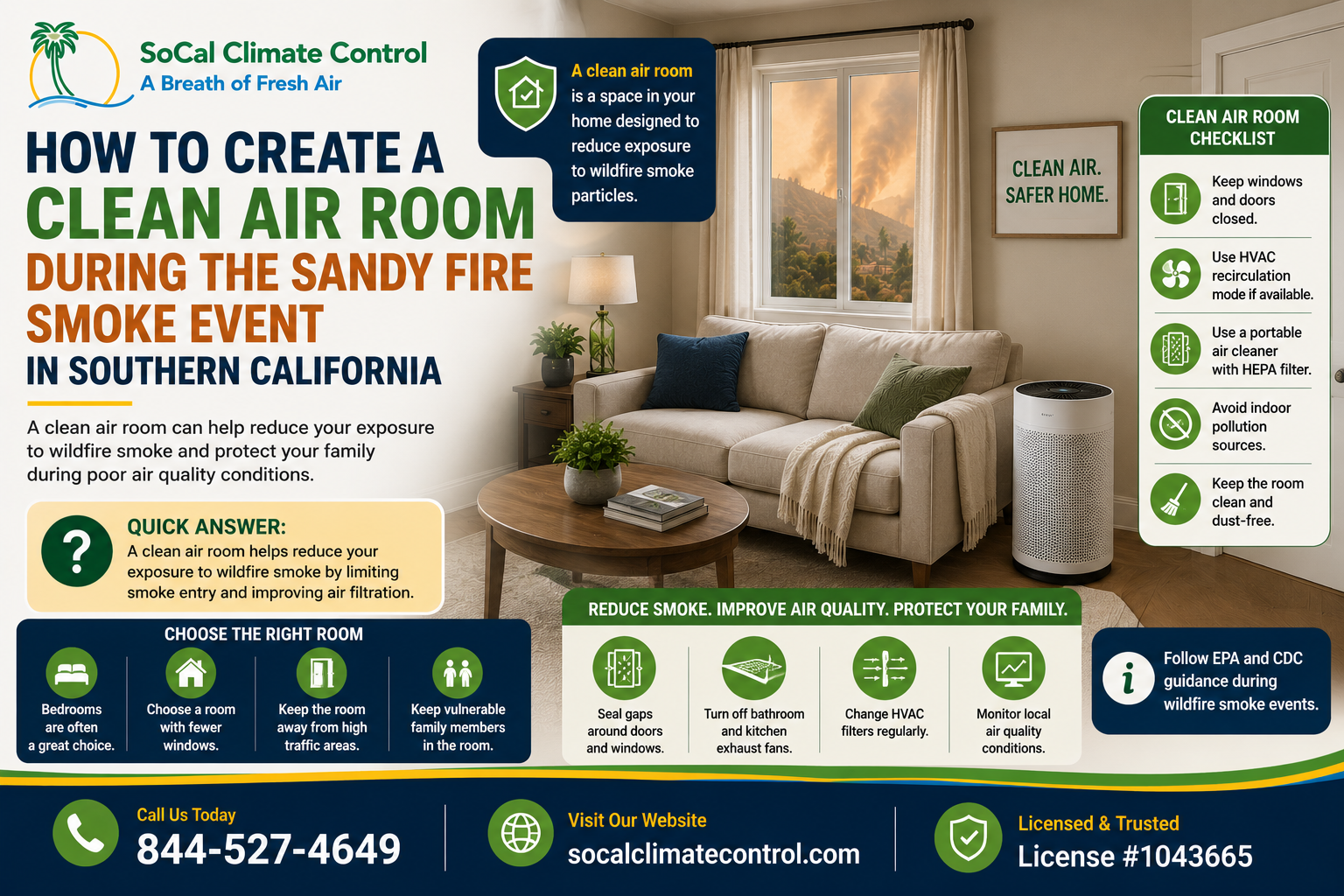
One of the most important recommendations from the EPA during wildfire smoke events is creating a “clean air room” inside the home. A clean air room is a space designed to reduce smoke exposure indoors by limiting smoke infiltration and improving air filtration.
For residents in Simi Valley, Moorpark, Thousand Oaks, Agoura Hills, Westlake Village, Calabasas, Woodland Hills, West Hills, Chatsworth, and surrounding Southern California communities, a clean air room may help reduce exposure to wildfire smoke particles during poor air quality conditions.
Quick Answer: What Is a Clean Air Room During Wildfire Smoke?
According to the EPA, a clean air room is a room inside the home designed to reduce exposure to wildfire smoke particles. During the Sandy Fire smoke event, homeowners in Simi Valley, Agoura Hills, Westlake Village, Thousand Oaks, Moorpark, and surrounding Southern California communities may improve indoor air quality by keeping windows and doors closed, using HVAC recirculation settings when available, reducing indoor pollution sources, and using a properly sized portable air cleaner in a designated room.
This guide explains what a clean air room is, how to create one safely, what the EPA recommends during wildfire smoke events, and how Southern California homeowners can improve indoor air quality during smoke conditions.
Why the Sandy Fire Increased Indoor Air Quality Concerns
The Sandy Fire near Simi Valley created smoke conditions that affected many communities throughout Ventura County and portions of western Los Angeles County.
Even homeowners far from evacuation zones reported smoke odors, haze, and poor indoor air quality depending on local wind conditions and smoke movement.
Communities including Simi Valley, Moorpark, Thousand Oaks, Agoura Hills, Westlake Village, Calabasas, Woodland Hills, West Hills, and Chatsworth experienced changing air quality conditions during the fire event.
For families with children, seniors, asthma sufferers, or individuals with respiratory conditions, indoor air quality became a major concern during periods of elevated smoke.
Official fire updates: CAL FIRE Sandy Fire Incident Page
What Is a Clean Air Room?
The EPA recommends creating a clean air room during wildfire smoke events to help reduce indoor smoke exposure.
A clean air room is:
- a room with reduced smoke infiltration
- a space where windows and doors remain closed
- an area with filtered air circulation
- a safer indoor location for sensitive individuals during smoke events
The purpose of the room is to lower the amount of smoke particles people breathe indoors during poor air quality conditions.
EPA clean room guidance: Create a Clean Room During Wildfire Smoke Events
Who Should Use a Clean Air Room?
According to the CDC and EPA, wildfire smoke may be especially harmful for:
- children
- older adults
- pregnant individuals
- people with asthma
- people with COPD
- individuals with heart disease
- people sensitive to smoke exposure
Families with vulnerable household members may benefit most from creating a clean air room during wildfire smoke events like the Sandy Fire.
CDC wildfire smoke resource: CDC Wildfire Smoke Safety
How to Choose the Best Room for a Clean Air Space
The EPA recommends selecting a room that can be kept closed off from outdoor smoke as much as possible.
Good clean air room options may include:
- bedrooms
- family rooms
- home offices
- rooms with fewer windows
- rooms where family members spend significant time
Rooms to avoid may include:
- garages
- unfinished attics
- rooms with obvious air leaks
- areas connected directly to outdoor ventilation
For larger homes in Agoura Hills, Westlake Village, Calabasas, and Thousand Oaks, homeowners may want to choose a room that can be isolated from larger open-air floorplans.
How Wildfire Smoke Enters Homes
Even with windows closed, wildfire smoke can still enter homes.
According to the EPA, smoke may enter through:
- doors and windows
- small gaps and cracks
- attic ventilation
- bathroom fans
- kitchen exhaust systems
- HVAC systems with outdoor air intake
- leaky duct systems
- fireplace dampers
This is why some homeowners notice smoke odors indoors even when they try to seal the home during wildfire events.
Should You Use Your HVAC System During Wildfire Smoke?
In many cases, yes — but settings matter.
The EPA recommends using recirculation settings when available to reduce outdoor smoke entering the home.
Recirculation mode helps the HVAC system circulate indoor air rather than pulling in outdoor air.
However, not all HVAC systems operate the same way. Some homes have fresh-air ventilation systems or outside air intake features that may continue introducing outdoor air unless adjusted properly.
Homeowners who are unsure how their system operates may benefit from an HVAC inspection.
Why HVAC Filters Matter During Smoke Events
HVAC filters are one of the first lines of defense during wildfire smoke conditions.
According to the EPA, higher-efficiency filters may help reduce fine smoke particles indoors if the HVAC system can safely support them.
Many homeowners use:
- MERV 11 filters
- MERV 13 filters
- portable HEPA air cleaners
However, not every HVAC system is designed for highly restrictive filters. Installing an incompatible filter may reduce airflow or strain equipment.
An HVAC technician can help determine what filter type is appropriate for your system.
Should You Use a Portable Air Cleaner?
The EPA states that portable air cleaners may help reduce smoke particles indoors when properly sized for the room.
Portable HEPA air cleaners are commonly used in clean air rooms during wildfire smoke events.
When using a portable air cleaner:
- choose a unit sized for the room
- keep doors and windows closed
- follow manufacturer instructions
- replace filters as recommended
Portable air cleaners should complement—not replace—overall indoor air quality management.
Indoor Activities to Avoid During Smoke Events
The EPA recommends avoiding indoor activities that create additional indoor pollution during wildfire smoke conditions.
Activities to limit may include:
- burning candles
- smoking indoors
- using fireplaces
- burning incense
- vacuuming without HEPA filtration
- frying foods that create smoke
These activities may increase particle levels indoors and reduce the effectiveness of a clean air room.
Can Smoke Odors Remain Indoors After Air Quality Improves?
Yes. Smoke odors may continue indoors even after outdoor conditions improve.
Smoke particles may settle into:
- carpet
- furniture
- curtains
- dust
- attic insulation
- HVAC filters
- duct systems
This is why some homes continue smelling smoky after wildfire events.
If odors continue when the HVAC system operates, homeowners may want to inspect:
- air filters
- return vents
- duct leakage
- airflow issues
- possible contamination areas
How Homes in Agoura Hills & Westlake Village May Experience Smoke Differently
Homes in Agoura Hills, Westlake Village, Calabasas, Thousand Oaks, and nearby hillside communities may experience smoke conditions differently depending on:
- terrain
- elevation
- wind patterns
- home size
- attic ventilation
- HVAC system layout
Larger homes with multi-zone HVAC systems may require more detailed airflow and filtration evaluations during wildfire season.
Local Air Quality & Emergency Resources
Southern California homeowners should monitor official resources during wildfire smoke events.
- AirNow AQI
- South Coast AQMD Advisories
- CAL FIRE Sandy Fire Updates
- Ventura County Emergency Information
- Los Angeles County Emergency Preparedness
When Should You Schedule an HVAC Inspection?
Homeowners in Simi Valley, Moorpark, Thousand Oaks, Agoura Hills, Westlake Village, Calabasas, Woodland Hills, West Hills, Chatsworth, and nearby communities may want to schedule an HVAC inspection if:
- Smoke odors continue indoors
- Filters become dirty unusually fast
- Airflow decreases
- Dust or soot appears near vents
- The HVAC system struggles during smoke conditions
- Indoor air quality concerns continue after smoke conditions improve
For local help, visit HVAC indoor air quality specialists in Simi Valley.
Frequently Asked Questions
What is a clean air room?
A clean air room is a room inside the home designed to reduce wildfire smoke exposure by limiting smoke infiltration and improving air filtration.
Should I use my HVAC system during wildfire smoke?
In many cases, homeowners use HVAC recirculation mode to help reduce outdoor smoke entering the home.
Can wildfire smoke enter homes with the windows closed?
Yes. Smoke may enter through ventilation systems, attic gaps, duct leakage, doors, windows, and small openings throughout the home.
Should I use a portable air cleaner during wildfire smoke?
The EPA states that properly sized portable air cleaners may help reduce smoke particles indoors.
What cities were affected by Sandy Fire smoke?
Smoke conditions affected communities including Simi Valley, Moorpark, Thousand Oaks, Agoura Hills, Westlake Village, Calabasas, Woodland Hills, West Hills, Chatsworth, and nearby Southern California areas.
Can smoke odors remain indoors after wildfire conditions improve?
Yes. Smoke particles may settle into carpet, furniture, insulation, filters, dust, and HVAC systems.
The Sandy Fire reminded Southern California homeowners how important indoor air quality preparation has become during wildfire season.
Creating a clean air room can help reduce smoke exposure indoors, especially for families with children, seniors, asthma sufferers, or individuals sensitive to smoke.
The best approach is to follow official health guidance, monitor local AQI conditions, reduce smoke infiltration, maintain HVAC filtration properly, and schedule an HVAC inspection if smoke odors or airflow problems continue after smoke conditions improve.
Helpful resources: