Last Updated: May 2026
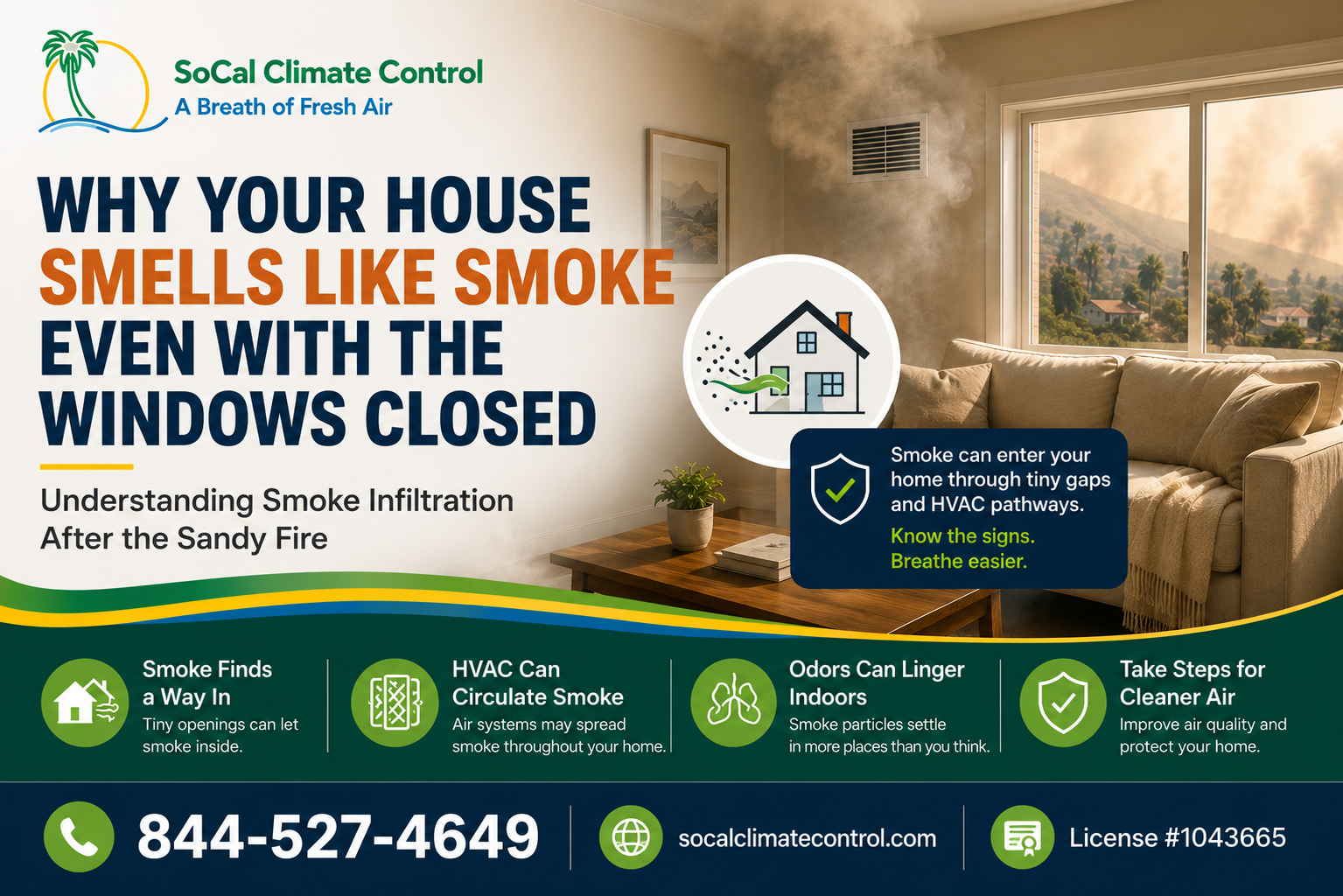
After the Sandy Fire in Ventura County, many homeowners across Simi Valley, Moorpark, Thousand Oaks, Agoura Hills, Westlake Village, Calabasas, Woodland Hills, West Hills, Chatsworth, and surrounding Southern California communities noticed something frustrating: their homes smelled like smoke even with the windows closed.
According to the EPA, wildfire smoke can enter homes through small cracks, gaps, ventilation systems, attic spaces, doors, windows, and HVAC systems that move outdoor air indoors. This means a house can still experience smoke odors and indoor air quality problems even when homeowners try to seal the home as much as possible.
Quick Answer: Why Does My House Smell Like Smoke With the Windows Closed?
According to the EPA, wildfire smoke can enter homes through ventilation systems, attic gaps, duct leakage, return vents, fireplaces, exhaust fans, doors, and small openings around the home. During the Sandy Fire smoke event, homeowners across Simi Valley, Agoura Hills, Westlake Village, and nearby Southern California communities may have experienced indoor smoke odors even with windows closed because fine smoke particles can travel through tiny openings and HVAC air pathways.
This article explains how wildfire smoke enters homes, why smoke odors may linger indoors after the Sandy Fire, what government agencies recommend, and how Southern California homeowners can improve indoor air quality safely and realistically.
How the Sandy Fire Affected Indoor Air Quality Across Southern California
The Sandy Fire began in Ventura County near Simi Valley and quickly became a major wildfire event affecting nearby communities through smoke exposure, changing air quality conditions, and evacuation activity.
Even homeowners outside evacuation zones reported smoke odors and haze indoors. This is common during wildfire events because smoke can travel significant distances depending on wind conditions, terrain, and atmospheric pressure.
Communities including Simi Valley, Moorpark, Thousand Oaks, Agoura Hills, Westlake Village, Calabasas, Woodland Hills, and parts of the San Fernando Valley experienced changing smoke conditions during the Sandy Fire.
Official fire information: CAL FIRE Sandy Fire Incident Page
How Wildfire Smoke Enters Homes
The EPA explains that wildfire smoke can enter homes through multiple pathways. Smoke particles are extremely small, which means they can move into buildings even when homeowners keep doors and windows closed.
Common smoke entry points include:
- Open doors and windows
- Small gaps around windows and doors
- Attic ventilation openings
- Bathroom exhaust fans
- Kitchen exhaust systems
- Fireplace dampers
- HVAC systems with outdoor air intake
- Leaky air ducts
- Garage-to-home air leakage
- Poorly sealed return vents
In Southern California homes, especially older homes or homes with attic duct systems, smoke infiltration may become more noticeable during large wildfire smoke events.
EPA resource: Wildfires and Indoor Air Quality
Why Smoke Odors Can Linger Indoors
One of the biggest frustrations homeowners experience after wildfire smoke exposure is that smoke odors may continue indoors even after outdoor conditions improve.
This can happen because smoke particles settle into:
- HVAC filters
- Carpets and rugs
- Furniture and upholstery
- Curtains and fabric materials
- Dust inside the home
- Attic insulation
- Duct systems
- Return air pathways
When the HVAC system turns on, air movement may recirculate trapped odor particles throughout the home.
Some homeowners notice the smell becomes stronger:
- when the air conditioner turns on
- during heating cycles
- after replacing filters
- during windy conditions
- when outdoor temperatures change
This does not automatically mean the HVAC system is damaged. It often means smoke particles or odor residue remain somewhere within the indoor environment.
Can Smoke Enter Through Air Vents?
Yes. Smoke can enter homes through HVAC systems and ventilation pathways.
According to the EPA, homes and buildings with ventilation systems or HVAC equipment that introduces outdoor air may allow smoke particles indoors during wildfire events.
In some homes, smoke may also move through:
- leaky return ducts
- attic duct leakage
- unsealed duct joints
- fresh air ventilation systems
- whole-house fans
Homes in hillside and valley communities such as Agoura Hills, Westlake Village, Calabasas, Woodland Hills, and Thousand Oaks may experience smoke differently depending on local wind patterns and terrain.
Why Some Homes Smell Worse Than Others
Two homes in the same neighborhood may experience completely different indoor smoke conditions during the same wildfire event.
Factors that may affect smoke infiltration include:
- Age of the home
- Condition of windows and doors
- Attic ventilation design
- HVAC filter condition
- Duct leakage
- Insulation quality
- Outdoor wind exposure
- Whether the home uses recirculation mode
Larger homes in Agoura Hills, Westlake Village, Calabasas, and Thousand Oaks may also have multi-zone HVAC systems with more complex duct layouts and multiple return pathways.
What Government Agencies Recommend During Wildfire Smoke Events
The EPA and CDC recommend reducing smoke entry into the home during wildfire events.
Recommended steps include:
- Keep windows and doors closed
- Use HVAC recirculation settings when available
- Reduce outdoor air entering the home
- Use portable air cleaners if appropriate
- Replace dirty HVAC filters
- Avoid burning candles or creating indoor smoke
- Monitor local air quality conditions
The Los Angeles County Department of Public Health also advises residents to stay indoors when smoke levels are elevated and to monitor official air quality updates.
Local health guidance: Los Angeles County Wildfire Smoke Guidance
Should You Replace Your HVAC Filter After the Sandy Fire?
Checking your HVAC filter after wildfire smoke exposure is a smart idea.
Smoke particles can load HVAC filters faster than normal. A filter that usually lasts one to three months may become dirty much sooner during wildfire smoke conditions.
Signs your filter may need replacement include:
- Visible darkening or gray buildup
- Dust accumulation around vents
- Reduced airflow
- Persistent indoor smoke odors
- Filter clogging shortly after installation
Some homeowners upgrade to higher-efficiency filters during wildfire season. However, not every HVAC system is designed for very restrictive filters. A technician can help determine what filter type is compatible with your system.
Should You Clean Your Air Ducts After Wildfire Smoke?
Duct cleaning is not automatically required after every wildfire smoke event.
The EPA advises homeowners to avoid companies making blanket claims that all homes require duct cleaning after smoke exposure.
However, duct inspection and cleaning may be appropriate if:
- There is visible soot or ash inside accessible ductwork
- Smoke odors continue when the HVAC system runs
- Dust or debris blows from vents
- The home experienced heavy ash intrusion
- An inspection identifies contamination
For homeowners looking for more information, visit air duct cleaning services in Simi Valley and surrounding Southern California communities.
How to Improve Indoor Air Quality After the Sandy Fire
Southern California homeowners can take several practical steps to improve indoor air quality after wildfire smoke exposure.
Recommended actions include:
- Replace dirty HVAC filters
- Use HVAC recirculation mode when possible
- Monitor AQI before opening windows
- Seal obvious air leaks
- Use portable HEPA air cleaners if appropriate
- Vacuum with HEPA filtration
- Clean surfaces where ash or dust settled
- Avoid indoor smoke sources
For households with asthma sufferers, seniors, children, or individuals with respiratory conditions, improving indoor air quality may be especially important after wildfire smoke events.
Local Air Quality Resources for Southern California Residents
Homeowners should monitor official air quality and emergency resources during and after wildfire smoke events.
- AirNow Air Quality Index
- South Coast AQMD Advisories
- CAL FIRE Sandy Fire Updates
- Ventura County Emergency Information
- Los Angeles County Emergency Preparedness
When Should You Schedule an HVAC Inspection?
Homeowners in Simi Valley, Agoura Hills, Westlake Village, Thousand Oaks, Moorpark, Calabasas, Woodland Hills, West Hills, and nearby communities may want to schedule an HVAC inspection if:
- Smoke smell continues indoors
- The HVAC system smells smoky when operating
- Filters become dirty unusually fast
- Airflow decreases
- Dust or soot appears near vents
- Indoor air quality symptoms continue
An HVAC inspection may help identify:
- filter issues
- duct leakage
- airflow problems
- ventilation concerns
- possible contamination areas
For local help, visit HVAC indoor air quality specialists in Simi Valley.
Frequently Asked Questions
Why does my house smell like smoke even when the windows are closed?
Wildfire smoke can enter homes through ventilation systems, attic spaces, duct leakage, gaps around windows and doors, fireplaces, and HVAC systems that bring in outdoor air.
Can wildfire smoke come through air vents?
Yes. Smoke can enter through HVAC systems, duct leakage, fresh air intake systems, and ventilation pathways.
Should I replace my HVAC filter after wildfire smoke exposure?
Yes, homeowners should check their HVAC filter after smoke exposure and replace it if it appears dirty or clogged.
Is duct cleaning always necessary after wildfire smoke?
No. The EPA recommends inspection-based evaluations rather than automatic duct cleaning after wildfire smoke events.
What cities were affected by Sandy Fire smoke?
Smoke conditions affected areas including Simi Valley, Moorpark, Thousand Oaks, Agoura Hills, Westlake Village, Calabasas, Woodland Hills, West Hills, Chatsworth, and surrounding Southern California communities.
The Sandy Fire reminded Southern California homeowners how quickly wildfire smoke can affect indoor air quality, even miles away from the fire itself.
If your house smells like smoke even with the windows closed, the odor may be entering through HVAC systems, attic leakage, ventilation pathways, filters, or other openings throughout the home.
The best approach is to rely on official health guidance, monitor local air quality, reduce smoke entry, maintain HVAC filters properly, and schedule an inspection if smoke odors or airflow problems continue after smoke conditions improve.
Helpful resources: