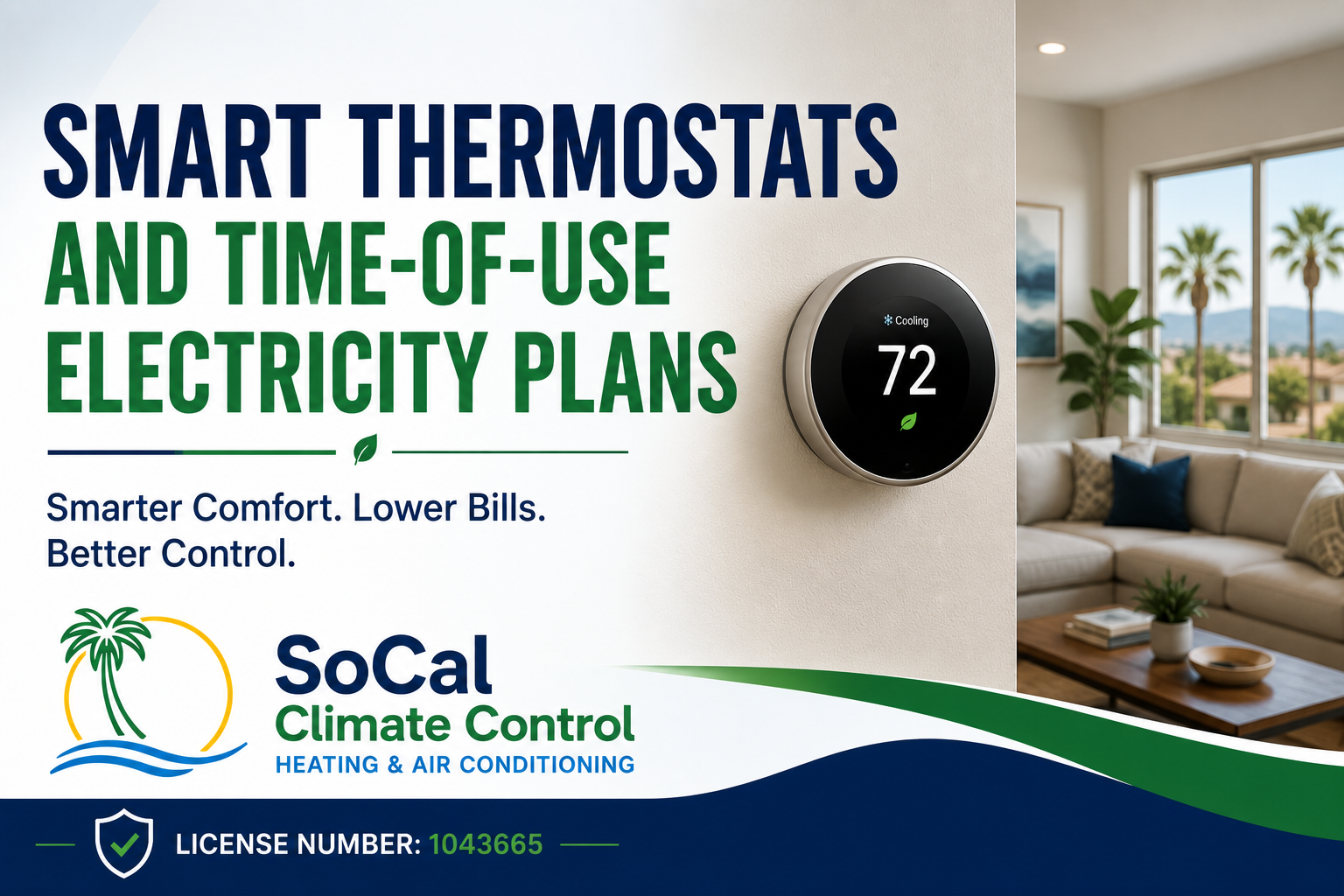
Introduction to Smart Thermostat
Quick Answer
Smart thermostats can help Southern California homeowners manage Time-of-Use electricity plans by automatically adjusting cooling schedules, reducing unnecessary AC runtime, and helping shift energy use away from expensive peak-rate periods. When paired with a properly maintained HVAC system, smart thermostats can improve comfort, support pre-cooling strategies, and help reduce summer cooling costs.
Key Takeaways
- Smart thermostats can help automate cooling schedules around Time-of-Use electricity plans.
- They can support pre-cooling before expensive peak-rate periods begin.
- Smart thermostats reduce waste by adjusting temperatures when the home is empty.
- They work best with properly maintained HVAC systems, sealed ducts, and good insulation.
- Older air conditioners may still limit savings even with smart thermostat optimization.
- Southern California homeowners can use smart thermostat settings to improve comfort during summer heat waves.
Smart Thermostats and Time-of-Use Electricity Plans
For many Southern California homeowners, summer comfort comes with a familiar problem: higher electric bills. Between rising utility costs, longer heat waves, and Time-of-Use electricity plans, the way you control your air conditioner matters more than ever.
One of the most practical tools for managing cooling costs is a smart thermostat. While a smart thermostat will not magically solve every energy problem, it can help homeowners make better cooling decisions, automate pre-cooling, reduce unnecessary runtime, and improve comfort throughout the day.
If your home is in Northridge, Porter Ranch, Woodland Hills, Thousand Oaks, or another warm Southern California community, a smart thermostat can be an important part of your HVAC energy-saving strategy.
What Is a Smart Thermostat?
A smart thermostat is a programmable thermostat that connects to Wi-Fi and gives homeowners more control over heating and cooling schedules.
Unlike older manual thermostats, smart thermostats can learn household patterns, track usage, adjust settings automatically, and allow remote control from a phone or tablet.
Common smart thermostat features include:
- Custom temperature schedules
- Remote access from mobile devices
- Energy usage reports
- Occupancy sensing
- Vacation settings
- Pre-cooling schedules
- Integration with smart home systems
These features are especially useful for homeowners trying to reduce cooling costs during high-demand electricity periods.
📍 Local Insight: Northridge
Northridge homeowners often deal with long summer cooling periods. A smart thermostat can help schedule cooling earlier in the day and reduce unnecessary AC runtime during peak afternoon heat.
How Smart Thermostats Work With Time-of-Use Electricity Plans
Time-of-Use electricity plans charge different rates depending on when electricity is used. Electricity is often more expensive during peak-demand periods and less expensive during off-peak periods.
Because air conditioning is one of the largest summer energy users in the home, cooling during peak-rate periods can significantly affect monthly utility costs.
A smart thermostat can help by automatically adjusting your cooling schedule around these rate periods.
For example, a homeowner may use a smart thermostat to:
- Cool the home before peak rates begin
- Raise the thermostat slightly during expensive hours
- Reduce cooling when no one is home
- Resume normal comfort settings later in the evening
To understand how rate timing affects air conditioning costs, read:
What SCE Time-of-Use (TOU) Rates Mean for Your Air Conditioner.
Smart Thermostats and Pre-Cooling
Pre-cooling is one of the most useful strategies for homeowners on Time-of-Use plans.
Instead of waiting until your home becomes hot during the most expensive hours of the day, a smart thermostat can begin cooling earlier, before peak pricing periods begin.
This allows your home to start the peak period at a more comfortable temperature. Then, during expensive hours, the thermostat can reduce runtime by allowing the indoor temperature to rise slightly while still maintaining comfort.
This strategy works best when the home can hold cooled air well.
For more details, read:
Pre-Cooling Your Home: The HVAC Strategy Utility Companies Want You To Know.
Can Smart Thermostats Lower Electric Bills?
A smart thermostat can help reduce electric bills, but the results depend on how it is used and the condition of your home comfort system.
Smart thermostats may help lower costs by:
- Reducing unnecessary cooling
- Improving schedule consistency
- Supporting pre-cooling
- Reducing runtime when the home is empty
- Helping homeowners understand energy usage patterns
However, a smart thermostat cannot fully overcome major efficiency problems such as leaky ducts, poor insulation, dirty coils, or an aging air conditioner.
📍 Local Insight: Porter Ranch
Porter Ranch homes can experience strong sun exposure and high cooling demand. Smart thermostat schedules can help reduce waste, but ductwork and insulation still play a major role in comfort and efficiency.
Best Smart Thermostat Settings for Time-of-Use Plans
There is no single perfect thermostat setting for every home. The best schedule depends on your utility plan, comfort preferences, home insulation, household schedule, and HVAC system condition.
A common Time-of-Use strategy may include:
- Moderate cooling earlier in the day
- Pre-cooling before peak-rate periods
- Slightly higher thermostat settings during expensive hours
- Comfort recovery later in the evening
The key is to avoid extreme temperature swings. Setting the thermostat too low in the morning may cause unnecessary runtime, while setting it too high during peak hours may make the home uncomfortable.
Smart thermostats help find a better balance.
Vacation and Away Settings
One of the biggest benefits of smart thermostats is the ability to reduce energy waste when the home is empty.
Many homeowners leave the AC running longer than necessary because they want the home comfortable when they return. Smart thermostats solve this by allowing homeowners to schedule cooling before arrival instead of cooling an empty house all day.
Vacation and away settings can help:
- Reduce unnecessary runtime
- Prevent extreme indoor temperatures
- Protect pets and belongings
- Restore comfort before you return home
Do Smart Thermostats Help During Heat Waves?
Yes, but they are not a substitute for a properly performing HVAC system.
During a heat wave, a smart thermostat can help maintain a consistent schedule and avoid inefficient cooling patterns. It can also help pre-cool the home before outdoor temperatures peak.
However, if your air conditioner is undersized, poorly maintained, or near the end of its lifespan, a smart thermostat may not solve comfort issues by itself.
If your system is older, read:
Why Older Air Conditioners Cost More During High Electricity Rate Periods.
📍 Local Insight: Woodland Hills
Woodland Hills frequently sees extreme summer temperatures. Smart thermostats can help manage cooling schedules, but older HVAC systems may still struggle during prolonged heat waves.
Smart Thermostat Installation Considerations
Not every HVAC system is compatible with every smart thermostat. Some systems require specific wiring, power requirements, or configuration.
Before installing a smart thermostat, homeowners should consider:
- HVAC system compatibility
- Existing thermostat wiring
- Multi-zone system setup
- Heat pump compatibility
- Wi-Fi reliability
- Professional installation requirements
A properly installed smart thermostat can improve performance and prevent common setup issues.
Smart Thermostats Work Best as Part of a Bigger Efficiency Plan
A smart thermostat is a powerful tool, but it is only one part of an efficient home comfort strategy.
For best results, combine smart thermostat optimization with:
- Regular HVAC maintenance
- Clean air filters
- Duct inspections
- Attic insulation improvements
- Energy audits
- Whole house fans where appropriate
- High-efficiency HVAC upgrades when needed
For a broader guide, read:
How Southern California Homeowners Can Reduce Rising Electricity Bills Without Sacrificing Comfort.
📍 Local Insight: Thousand Oaks
Thousand Oaks homeowners often benefit from smart thermostat scheduling because many homes experience warm afternoons followed by cooler evenings, making timing an important part of comfort control.
Ready to Make Your HVAC System Smarter?
Smart thermostats can help Southern California homeowners control comfort, reduce energy waste, and better manage Time-of-Use electricity plans.
But the best results happen when your thermostat, HVAC system, ductwork, insulation, and airflow are all working together.
SoCal Climate Control can help evaluate your system, install compatible smart thermostat solutions, and recommend energy-saving strategies designed for your home and comfort needs.
Sources & References
Frequently Asked Questions About Smart Thermostats and Time-of-Use Electricity Plans
Can a smart thermostat lower my electric bill?
Do smart thermostats work with Time-of-Use electricity plans?
What is pre-cooling?
Are smart thermostats worth it in Southern California?
Can a smart thermostat help an older air conditioner?
Which smart thermostat is better: Nest or Ecobee?
Do smart thermostats work during heat waves?
Can I control a smart thermostat from my phone?
Will a smart thermostat work with my HVAC system?
How can SoCal Climate Control help with smart thermostat installation?
Ready to Make Your HVAC System Smarter?
A smart thermostat can be one of the easiest ways to improve comfort, reduce energy waste, and better manage Time-of-Use electricity rates. When paired with a properly maintained HVAC system, it can help homeowners take greater control over cooling costs throughout the year.
At SoCal Climate Control, we help homeowners evaluate thermostat compatibility, optimize HVAC performance, improve energy efficiency, and identify opportunities to lower utility costs.
Proudly Serving Homeowners Throughout:
Northridge • Woodland Hills • Encino • Chatsworth • Porter Ranch • Granada Hills • Reseda • Winnetka • Tarzana • Sherman Oaks • West Hills • Calabasas • Hidden Hills • Agoura Hills • Westlake Village • Thousand Oaks • Moorpark • Simi Valley • Camarillo • Newbury Park
Schedule an HVAC evaluation today and discover how smart technology can improve your home’s comfort and efficiency.
Related Articles
- How Southern California Homeowners Can Reduce Rising Electricity Bills Without Sacrificing Comfort
- What SCE Time-of-Use (TOU) Rates Mean for Your Air Conditioner
- Pre-Cooling Your Home: The HVAC Strategy Utility Companies Want You To Know
- Why Older Air Conditioners Cost More During High Electricity Rate Periods
- The 7 Biggest Mistakes Increasing Southern California Electric Bills
- Why Your Electric Bill Doubled This Summer
- Best Thermostat Settings to Save Money During California Heat Waves
- Energy Audits: The Fastest Way to Find Hidden Utility Bill Problems
- Whole House Fans vs Air Conditioning: Which Saves More Money?
- Southern California Energy Saving Checklist for Summer
Savings

Leave Us A Review


